
PROVIDING YOU WITH ALL THE BEST BETS
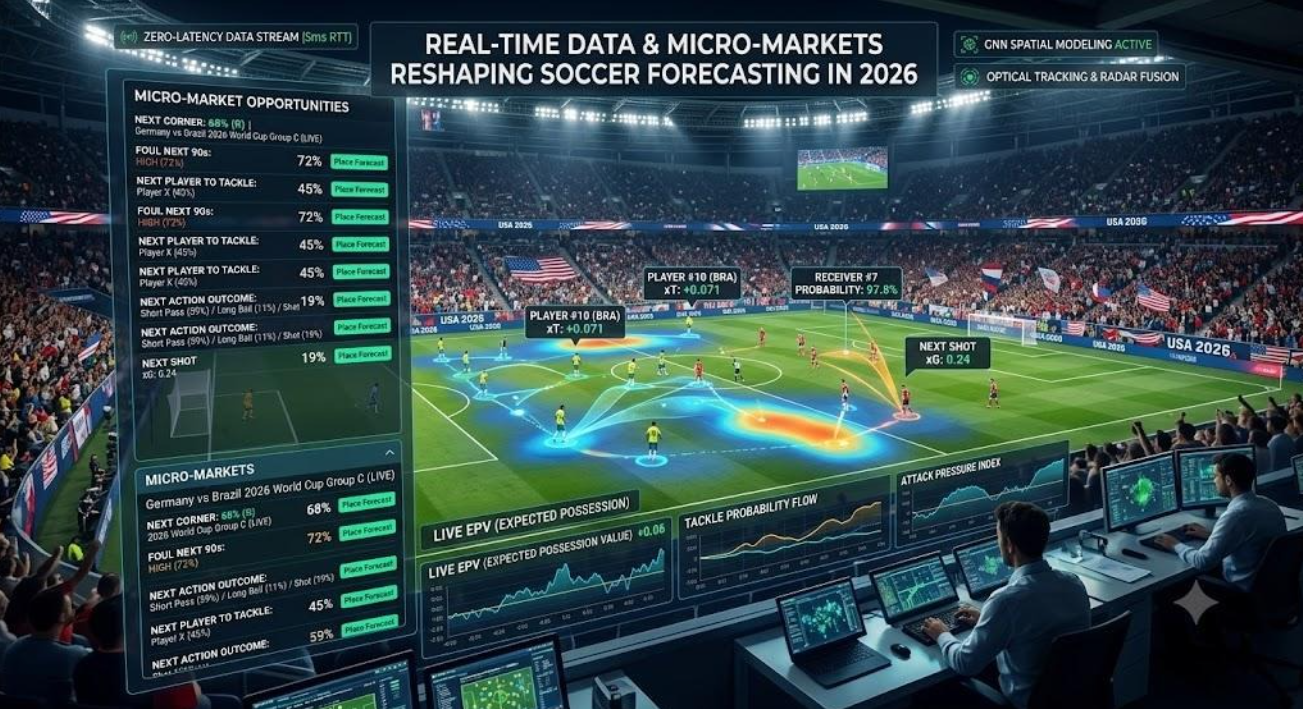
Image Credit - Gemini
The Death of the Ninety-Minute Baseline
For decades, the traditional approach to forecasting soccer was agonizingly slow and incredibly broad. Bettors analyzed historical form, checked the injury reports, and waited two hours to see if their overarching hypothesis held up against reality. Let's be real—that static, macro-level model is completely obsolete in 2026. The economic foundation of the sports industry now revolves entirely around the next ninety seconds. This evolution is defined by a massive proliferation of micro-markets, effectively breaking a single fixture into hundreds of self-contained, discrete events. Fans now wager on the specific outcome of the next corner kick or whether a heavily marked midfielder will complete a progressive pass. The mathematical reality of this shift is brutal for the casual fan but highly lucrative for sportsbooks. A single engaged user can comfortably execute thirty to fifty discrete transactions during one half of a World Cup match. Operators apply their mathematical margin repeatedly within highly compressed predictive loops. A lifetime of traditional betting volume is effectively compressed into a single afternoon.
Sensor Fusion and the Interpolation Lie
A high-frequency book requires absolute temporal precision to survive. You simply cannot price the outcome of a developing counterattack using standard API polling without bleeding capital to latency arbitrageurs. Modern platforms rely exclusively on streamed push architectures that capture sub-second telemetry directly from the pitch. Peek under the hood of the current tournament infrastructure. You'll find standard optical arrays mashed directly into millimeter-wave radar setups. Weather conditions—like heavy rain or massive stadium shadows—mean absolutely nothing to this hardware because it reads localized micro-Doppler signatures. A slide tackle registers completely differently than a standard pass.
The catch? These two vital data streams are hopelessly out of sync. The connected match ball samples its internal gyroscope at 500Hz, while the stadium roof cameras track player avatars at a much slower 50Hz. A professional winger at full sprint covers approximately twenty centimeters of grass within that tiny twenty-millisecond gap. Mathematical interpolation bridges this discrepancy by artificially snapping the ball's kinetic touch to an estimated camera frame. Governing bodies love to pretend this system is perfectly objective and infallible. Frankly, the entire sub-second data ecosystem is strictly bounded by its slowest feed, held together by continuous algorithmic guesswork.
Ditching the Grid for Neural Graphs
Analysts spent the last decade worshipping Expected Goals (xG) to grade terminal shot quality. Try using that static metric for live pricing today, and you will get mathematically slaughtered. It treats the complex tactical build-up like it never even happened. Granular forecasting demands that we value every single action on the pitch. The industry shifted heavily to Expected Possession Value (EPV) to evaluate non-shooting threats, but early models relied on a rigid, two-dimensional pitch grid. A grid structure assumes a memoryless sequence of events; soccer is fluid, chaotic, and continuous.
The intelligence layer pricing these odds today relies almost entirely on Graph Neural Networks (GNNs). This architecture maps the twenty-two players as interconnected nodes, while passing lanes and defensive pressure cones act as dynamic, weighted edges. Optical tracking data floods this framework constantly. This raw volume empowers real-time micro-market platforms. They can accurately predict the exact receiver of a pass before the ball even leaves a player's foot. Artificial intelligence is not just a peripheral marketing term for these vendors. It acts as the absolute core mathematical engine, calculating multi-agent geometric trajectories in under fifty milliseconds and proactively shifting odds before the human eye registers the developing pattern.
The Latency Arbitrage Bloodbath
Listen, if you are a bookmaker in this environment, every millisecond of delay is a death sentence. Sophisticated bettors know exactly how to exploit an operator relying on a sluggish data feed or a poorly optimized pricing model. Courtsiders sit physically in the stands with customized hardware, hammering maximum-limit wagers the exact second a referee points to the spot. They do this strictly to beat the central system's automated suspension trigger. Algorithmic traders operate on an even higher, more invisible level. They utilize co-located virtual servers and direct financial APIs to spot millisecond price discrepancies between a sharp global reference book and a slightly slower retail operator.
The reality is a relentless technological arms race fought entirely in the sub-second domain. Sportsbooks counter these programmatic attacks by deploying AI-driven defensive throttling mechanisms. If a user account sustains a seventy percent win rate on market positions held for less than thirty seconds, the risk engine immediately flags it as a mathematical impossibility for a recreational punter. The system then applies a customized, user-specific bet delay, holding the wager in digital limbo just long enough to revalidate the price. Arbitrageurs fight back using stake jitter. They randomize their bet sizes by small fractions to mask their behavioral footprint from the algorithms.
The Indian Tax Shock and the Attention Pivot
While North American operators focus entirely on squeezing margin out of high-frequency wagers, severe regulatory hostility forced a massive detour in the Indian market. Politicians abruptly obliterated the legal distinction between games of skill and games of chance via the PROG Act of 2025. Then came the absolute death blow. Intense industry lobbying failed completely when justices upheld a retrospective 28% tax on the full face value of all contest entries. Traditional real-money fantasy sports became commercially unviable overnight. Massive platforms were left staring at total collapse.
Survival dictated a brutal pivot for market giants like Dream11. Executives transitioned their entire business model into free-to-play, engagement-first sports entertainment ecosystems instead of chasing wagers. Raw fan attention and screen time are the new currency. Users now buy virtual tokens to participate in synchronized watch parties, answer live predictive polls during the broadcast, and tip influencers hosting the streams. Remarkably, the underlying predictive mechanics of the game easily survived the ban. Engineers simply repackaged those algorithms into a gamified social economy to bypass the regulatory minefield entirely.
The Augmented Viewing Floor
The commoditization of speed ensures that latency mitigation is a strict baseline requirement, not a unique competitive advantage. Media broadcasts are no longer linear, passive narratives delivered to a television set. They function as augmented, interactive interfaces layered heavily over a continuous stream of predictive data. If a fan wants to predict the next goalscorer, they expect to see that specific player's live EPV accumulation hovering dynamically above their head on the screen. Seamless integrations from major data providers merge ultra-low-latency video directly with betting slips inside a single mobile application.
Users do not even have to look away from the penalty shootout to confirm their financial exposure. Everything happens in one continuous digital breath. We are left with a massive, multi-agent dataset that is continuously, ruthlessly, and algorithmically traded until the final whistle blows.